
“Operate. Track. Improve. With Petra Business Suites, every part of your business moves forward — because what gets measured, gets mastered.”
Loading
“Operate. Track. Improve. With Petra Business Suites, every part of your business moves forward — because what gets measured, gets mastered.”

Client collaboration works best when it is structured, intentional, and easy to control.
In many organisations, project collaboration with clients and external stakeholders still happens through scattered email threads, ad-hoc updates, and disconnected follow-up. That often creates avoidable friction. Internal teams spend extra time deciding what to share, external contributors struggle to stay aligned, and project communication becomes harder to manage than it should be.
Petra is being refined to make that process more practical. Instead of treating external collaboration as an afterthought, Petra gives organisations a more structured way to involve clients and outside stakeholders while maintaining control over visibility, communication, and reporting.
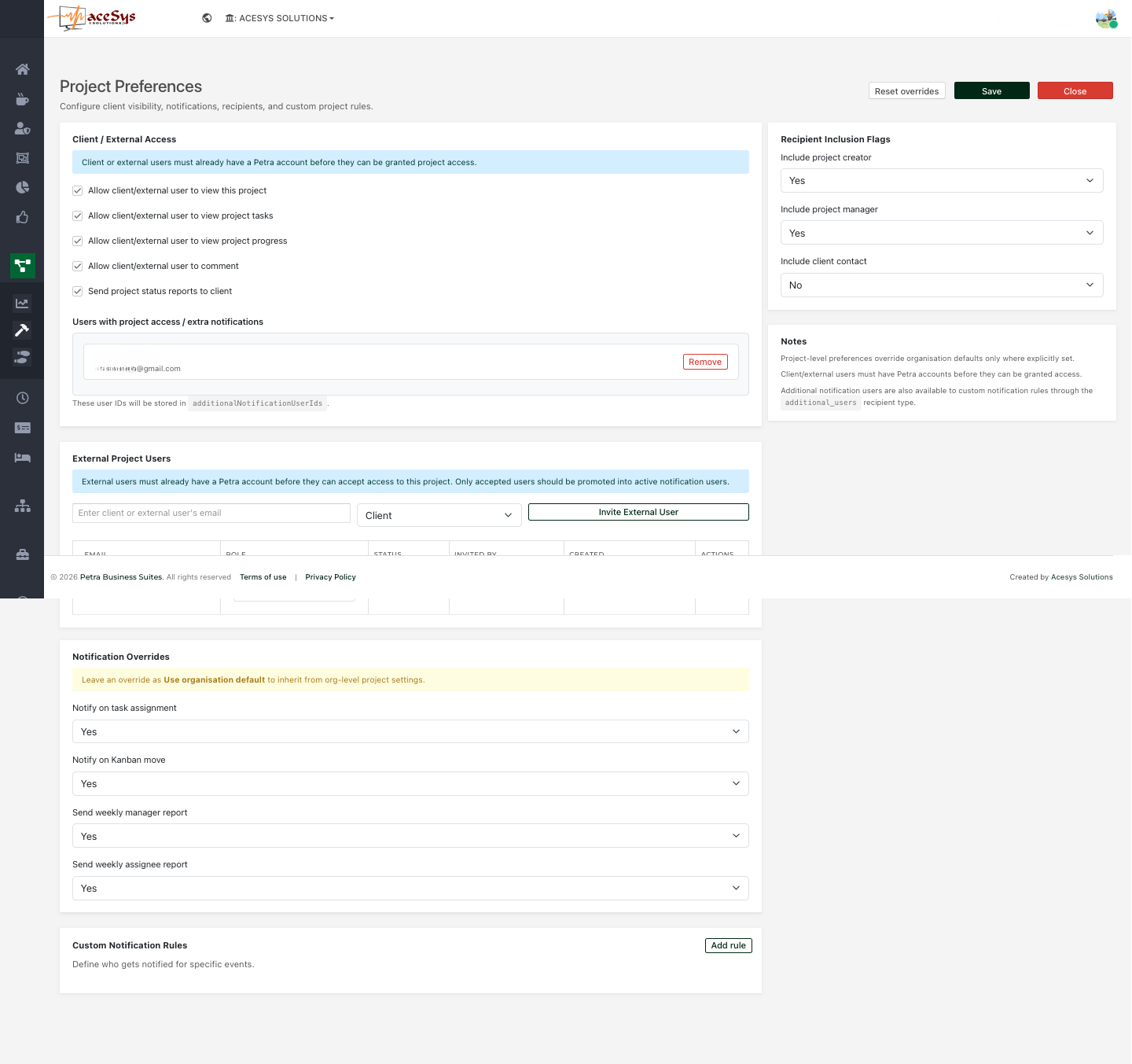
Petra Project Preferences give teams a project-level way to manage external access, reporting, notifications, and collaboration rules.
One of the biggest concerns organisations have when involving clients or external contributors in a project is control. Teams want stakeholders to stay informed, but they do not always want to expose every part of the internal workspace. In some cases, a client may only need to see progress. In others, they may need access to tasks, comments, or project status reports.
That is why project-level collaboration settings matter. Petra helps teams define how external access should work on a project-by-project basis, so collaboration can be opened up where necessary without becoming too broad or difficult to manage.
Not every stakeholder needs the same level of access. Some need to see the full project view. Others only need task visibility, progress updates, or the ability to comment when review is required.
Petra supports a more deliberate approach by making it possible to control whether a client or external user can view the project, view tasks, view progress, or participate in comments. That makes collaboration more useful because access is shaped around project needs rather than handled in an all-or-nothing way.
For organisations, that means outside stakeholders can remain informed without creating confusion around who should see what.
External collaboration should feel organised, not improvised. Petra supports this by making it easier to invite external users into a project, define their role, and manage them as part of the broader project structure.
This is especially useful for organisations working with clients, contractors, reviewers, consultants, implementation partners, or other outside contributors who need to stay involved in delivery without becoming part of the full internal operating environment.
By treating external users as recognised participants within the project, Petra helps reduce the communication gaps that often arise when stakeholder engagement is handled outside the platform.
Good collaboration is not only about access. It is also about communication rhythm.
When stakeholders are not kept informed consistently, teams end up repeating the same updates across multiple channels. Petra helps address this by supporting project-level notification choices and status reporting preferences that can be tailored to how each project is run.
That means organisations can decide when project stakeholders should receive reports, who should be included in updates, and how project communication should flow around assignments, movement, and weekly follow-up. Instead of relying entirely on manual outreach, teams can work with a more structured reporting approach.
Not all projects require the same collaboration model. A tightly controlled internal project may need minimal outside visibility, while a client-facing implementation may require more open review and reporting. Petra supports this difference by allowing collaboration preferences to be defined at the project level rather than forcing the same pattern across everything.
This is important because project collaboration works best when it reflects the reality of the work. Giving teams the ability to adjust access, recipients, and notification rules per project creates a more practical and professional working environment.
As organisations grow, external collaboration becomes more common. Clients want visibility. Consultants need access. Reviewers need a place to contribute. Delivery teams need a consistent way to manage all of that without losing structure.
Petra’s approach helps solve that challenge by creating a clearer framework for controlled collaboration. Rather than relying on fragmented communication or separate workarounds, organisations can keep more of the project conversation and reporting process within a single managed environment.
Collaboration with clients and external stakeholders should not have to feel messy or manual. It should be structured enough to protect internal workflow while still being open enough to keep the right people informed and engaged.
That is where Petra is creating real value. By improving how organisations control external access, reporting, and collaboration preferences at the project level, Petra is helping teams work more transparently, more professionally, and with much better coordination across project stakeholders.

Book a walkthrough and we will show how Petra connects the ideas in this article to real work tracking.
Petra Support
Share your details so our team can keep the conversation connected if you come back later.